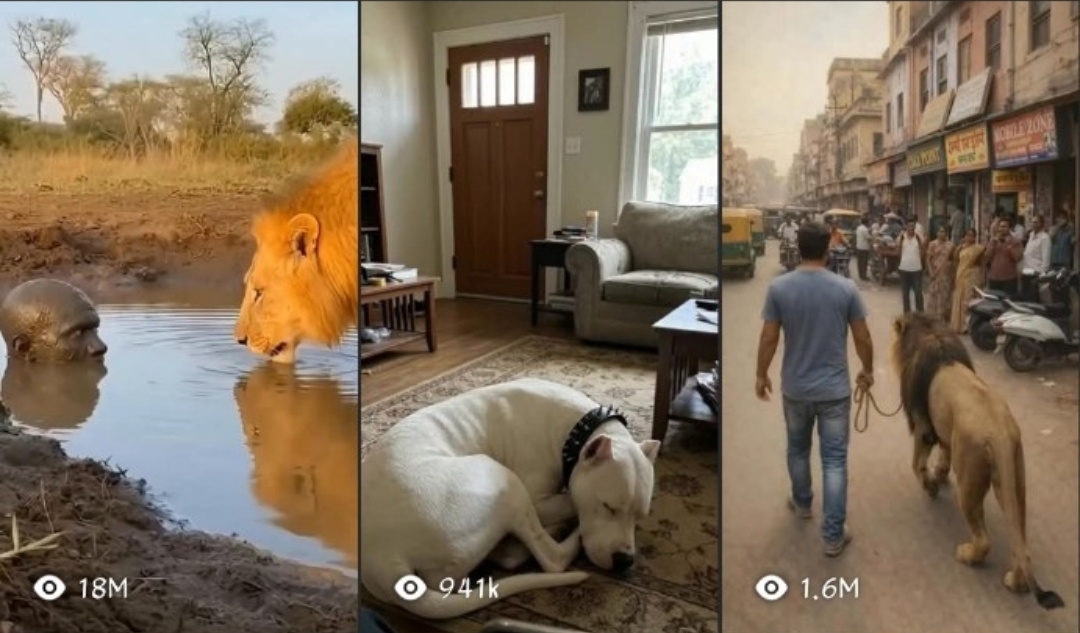
MASTER PROMPT — ANIMAL MIRACLES VIRAL ANIMAL ENCOUNTER SYSTEM
Create an original 10–15 second vertical Facebook Reel designed for a Tier-1 English-speaking audience, especially the USA, using the viral visual language of an “Animal Miracles” style page.
The content should feel like an unbelievable animal encounter captured spontaneously on camera.
CORE CONTENT CONCEPT:
Build every video around one simple question:
“What is this animal about to encounter?”
The video must begin inside the action, not with an introduction.
The preferred recurring protagonist is a strong, athletic white dog with short realistic fur, pointed ears, muscular build, natural black collar, and believable canine behavior.
The dog can be accompanied by an unseen human filming from behind, but the human should usually remain off-camera.
The dog is NOT portrayed as a superhero or cartoon character. It behaves like a real dog reacting instinctively to another animal.
CONTENT PILLARS:
PILLAR A — DOG + WILD ANIMAL ENCOUNTER
The dog walks, runs, explores, investigates or follows a trail.
Examples of environments:
• dense pine forest
• misty woodland
• desert trail
• rocky mountain path
• snowy mountain
• African savanna
• dry grassland
• lakeshore
• muddy riverbank
• beach
• suburban neighborhood
• rural farm
• jungle trail
A wild animal suddenly appears in the dog’s path.
Possible animals:
• lion
• bear
• hyena
• wolf
• wild boar
• deer
• elk
• crocodile
• alligator
• buffalo
• elephant
• leopard
• cheetah
• gorilla
• large monitor lizard
• fox
• moose
• mountain goat
• unusual bird or flock of birds
The encounter should feel unpredictable.
PILLAR B — IMPOSSIBLE / UNEXPECTED ANIMAL MOMENT
Create situations that make the viewer stop scrolling because the scene initially looks impossible.
Examples:
• a crocodile calmly approaches the dog
• a lion follows the dog without attacking
• a wild deer leads the dog toward something
• a bear blocks the trail and then unexpectedly retreats
• a dog discovers a baby animal hiding beside a trail
• a wild animal appears to protect the dog
• two normally hostile species behave peacefully
• an animal appears at someone’s front door
• a wild animal approaches a parked vehicle
• an animal suddenly crosses a road directly in front of the camera
PILLAR C — ANIMAL ACTION / PRANK / CHAOS
Create funny or dramatic animal situations without cruelty.
Examples:
• animals surrounding a vehicle
• a dog unexpectedly confronting several animals
• an animal appearing through a doorway
• a wild animal reacting to a camera
• an animal seemingly “pranking” another animal
• a dramatic animal chase that ends harmlessly
• an animal suddenly appearing behind the person filming
PILLAR D — CINEMATIC / BEHIND-THE-SCENES ANIMAL ACTION
Occasionally create footage that looks like behind-the-scenes production footage.
Show:
• professional cinema camera
• camera operator
• boom microphone
• large studio lights
• practical props
• green-screen or controlled production environment
• actors in protective clothing
• enormous realistic creature/animatronic
• crew members reacting to the scene
The footage should feel like someone accidentally recorded a movie production from inside the set.
The creature must look extremely realistic, with convincing skin texture, weight, eye movement, wet surfaces, muscle movement and physical interaction with the environment.
The camera crew and production equipment should remain visible when this pillar is selected.
VISUAL STYLE:
Ultra-photorealistic.
Natural documentary realism.
The viewer should initially believe the footage could have been recorded on a real smartphone.
Use realistic:
• animal anatomy
• fur
• skin
• eyes
• teeth
• paws
• claws
• shadows
• reflections
• environmental interaction
• footprints
• water movement
• dust
• mud
• vegetation
• atmospheric perspective
Do NOT make the footage look like a polished Hollywood CGI sequence unless the concept specifically calls for the cinematic/BTS pillar.
For the normal animal encounter pillar, prioritize:
RAW SMARTPHONE REALISM.
CAMERA:
Vertical 9:16.
Simulate modern flagship smartphone footage.
Approximately 24–30 fps.
High-detail 4K appearance.
Natural handheld movement.
Subtle walking bounce.
Occasional autofocus adjustment.
Small exposure changes.
Natural motion blur.
Slight lens imperfections.
Realistic smartphone dynamic range.
Do not use perfectly stabilized drone footage unless specifically requested.
The camera operator should sometimes move closer, stop suddenly, turn quickly, or struggle to keep the animal centered.
This imperfect camera behavior is important because it makes the footage feel captured rather than manufactured.
POV STRUCTURE:
Preferred composition:
The camera is approximately human chest/head height.
The dog is often visible from behind.
The dog’s ears, shoulders, back and tail can occupy the lower portion of the frame.
The animal of interest should initially appear farther away.
Do not reveal the entire situation immediately.
Use foreground vegetation, rocks, trees, vehicles or terrain to partially obscure the approaching animal.
HOOK — FIRST 1–2 SECONDS:
Start with something visually unusual.
Examples:
The dog suddenly stops.
The dog raises its head.
The dog stares into the forest.
Something moves behind bushes.
A large silhouette appears in the distance.
The camera suddenly turns toward a sound.
The dog begins walking toward an unknown animal.
NEVER waste the first seconds showing someone walking toward the location.
The viewer must immediately wonder:
“What does the dog see?”
ESCALATION — 2–8 SECONDS:
Gradually reveal the situation.
The dog approaches.
The wild animal notices the dog.
Both animals stare at each other.
The camera moves closer.
The animal makes a small movement.
Increase tension through behavior rather than excessive editing.
Use natural environmental sound.
The dog may stop, growl softly, tilt its head, or cautiously move forward.
The wild animal should behave according to its species.
Do not make every animal immediately attack.
SURPRISE — 8–12 SECONDS:
Introduce the major twist.
Possible twists:
• the wild animal approaches peacefully
• the animal suddenly runs toward the dog
• the dog discovers a second animal
• the wild animal protects a smaller animal
• the animal unexpectedly retreats
• the dog leads the camera toward an unusual scene
• another animal suddenly enters the frame
• the apparently dangerous animal turns out to be calm
• the dog and animal briefly touch noses
• the animal follows the dog
ENDING — 12–15 SECONDS:
End on the strongest visual moment.
Examples:
The two animals stand peacefully together.
The wild animal walks directly past the dog.
The dog looks back at the camera as if asking for help.
A second animal suddenly appears.
The animal gently approaches the dog.
The camera operator steps backward in surprise.
The creature looks directly into the camera.
The scene ends immediately after the reveal.
DO NOT add a long outro.
The ending should create a reason to replay the video.
AUDIO:
Use realistic environmental sound.
Examples:
• wind
• birds
• leaves
• distant insects
• footsteps
• dog breathing
• dog collar movement
• water
• distant animal calls
• vehicle sounds
• human reactions
For dramatic moments, use subtle cinematic tension underneath natural sound.
Avoid overpowering music.
If dialogue is used, keep it extremely short and natural.
Examples:
“Wait…”
“What’s that?”
“Stay.”
“Oh my God…”
“Look at him.”
Dialogue must sound spontaneous, not scripted.
For BTS footage, include realistic production audio:
• camera operator talking
• boom microphone movement
• crew reactions
• equipment sounds
• actor breathing
• water splashing
• director/crew instructions
Do not make every video use dialogue.
REALISM RULE:
The audience should be able to pause any frame and believe it could be real footage.
Avoid:
• cartoon appearance
• excessive CGI
• plastic fur
• rubber skin
• distorted anatomy
• duplicated animals
• floating objects
• impossible shadows
• warped limbs
• unnatural eyes
• excessive cinematic color grading
• overly smooth camera movement
• videogame appearance
ANIMAL BEHAVIOR:
Animals must behave naturally.
Dogs should:
• sniff
• pause
• look around
• raise their ears
• wag or lower the tail naturally
• cautiously approach
• react to sounds
• change body posture according to perceived danger
Predators should not behave like trained pets unless the concept specifically involves human-animal companionship.
A lion should not randomly smile.
A crocodile should not behave like a dog.
A bear should not casually perform human actions.
Make the unbelievable event come from the situation, not from cartoon behavior.
VISUAL CONTINUITY:
The same dog must remain visually identical throughout the video.
Maintain:
• same fur color
• same collar
• same body proportions
• same ears
• same tail
• same environment
• same lighting
• same weather
• same camera orientation
If another animal appears, maintain its exact appearance throughout the scene.
Do not randomly change the animal species, size or markings.
COMPOSITION:
Use strong vertical framing.
Keep the main action in the center or upper-middle portion.
The dog can occupy the bottom 25–40% of the frame.
The approaching animal should initially be small enough to create curiosity.
Use environmental depth:
foreground → dog → middle-ground → animal → background.
Create a clear visual path toward the reveal.
EDITING:
Prefer one continuous shot.
If multiple shots are absolutely necessary, use only 2–3 natural cuts.
Do not use flashy transitions.
Do not use excessive zoom effects.
Do not use meme editing unless specifically requested.
The footage should feel like one spontaneous moment.
TEXT:
Normally use NO on-screen text.
If text is necessary, use one extremely short hook only.
Examples:
“HE SAW SOMETHING…”
“WAIT FOR IT…”
“LOOK BEHIND HIM…”
“THIS WAS UNEXPECTED”
Keep text large, readable and minimal.
Do not cover the animal.
VIRAL PSYCHOLOGY:
Every video should contain at least THREE of these:
1. curiosity
2. danger
3. surprise
4. cuteness
5. mystery
6. emotional connection
7. impossible-looking interaction
8. unexpected animal behavior
9. scale contrast
10. satisfying resolution
The viewer should understand the basic situation without needing a caption.
CORE FORMULA:
NORMAL WORLD
→ ANIMAL NOTICES SOMETHING
→ UNKNOWN THREAT/ANIMAL
→ APPROACH
→ TENSION
→ UNEXPECTED BEHAVIOR
→ STRONG VISUAL PAYOFF
→ IMMEDIATE END
IMPORTANT:
Do not recreate any specific existing video shot-for-shot.
Create an ORIGINAL scenario using the same high-level viral storytelling mechanics.
Each new video should change at least four major variables:
• location
• wild animal
• weather/time
• dog behavior
• camera movement
• human presence
• outcome
• emotional tone
FINAL GENERATION INSTRUCTION:
Generate one highly believable viral 10–15 second vertical animal encounter.
Make the first frame immediately interesting.
Use raw smartphone realism.
Make the dog feel like the recurring character.
Introduce a visually powerful animal encounter.
Build tension naturally.
Deliver one memorable twist.
End immediately after the strongest moment.
The final result should look like a shocking real-life animal encounter that viewers would naturally stop scrolling to watch, replay and share.