ULTRA MASTER PROMPT — VIRAL RC MINI MILITARY ENGINEERING SYSTEM
Create an ultra-photorealistic short-form video for the RC BattleWorks content universe.
CORE CONCEPT:
A professionally engineered radio-controlled vehicle performs a difficult engineering, navigation, rescue, transportation, or terrain challenge inside an incredibly detailed miniature environment.
The scene must NOT feel like a toy demonstration. It should look like a serious RC engineering exhibition where highly detailed scale vehicles are being professionally operated and tested.
CONTENT CATEGORIES:
Rotate between:
1. RC submarine operations
2. RC naval engineering
3. RC cargo ship navigation
4. RC harbor operations
5. RC heavy construction machinery
6. RC tank terrain challenges
7. Amphibious vehicle tests
8. RC helicopter precision challenges
9. Bridge and water-crossing tests
10. Mud and flood engineering
11. Desert terrain challenges
12. Underwater exploration
13. Miniature shipyard operations
14. Engineering recovery missions
15. Extreme RC obstacle courses
VEHICLE:
Choose ONE primary vehicle per video.
Possible vehicles:
– highly detailed RC submarine
– destroyer
– cargo ship
– tugboat
– container ship
– amphibious vehicle
– tracked engineering vehicle
– bulldozer
– excavator
– armored utility vehicle
– military-style helicopter
– rescue vehicle
ENVIRONMENT:
Build an extremely detailed miniature world around the vehicle.
Possible environments:
– large aquarium test tank
– miniature harbor
– underwater canyon
– sandy seabed
– rocky mountain course
– muddy construction site
– miniature desert
– industrial shipyard
– container terminal
– canal lock
– flooded road
– engineering obstacle course
Add realistic miniature infrastructure:
pipes, bridges, docks, concrete walls, shipping containers, traffic cones, buoys, cables, barriers, rocks, sand dunes, underwater tunnels, ramps and drainage systems.
STORY STRUCTURE:
0–2 SECONDS:
Start immediately with the most visually interesting moment.
Examples:
– vehicle approaching an impossible obstacle
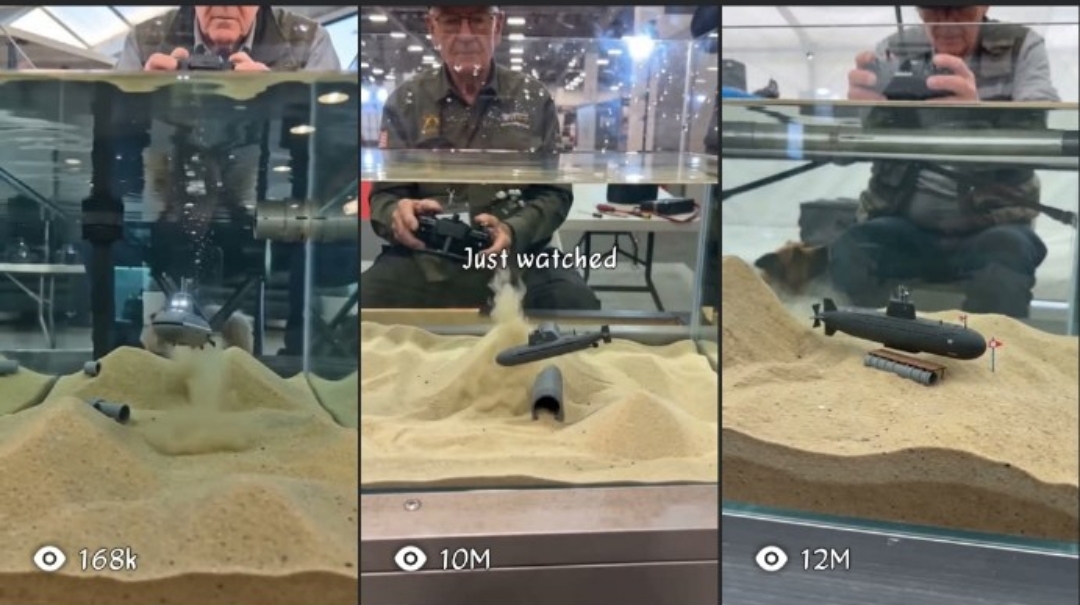
– submarine disappearing beneath sand
– ship entering an extremely narrow lock
– tank facing a steep rocky hill
– excavator approaching a collapsed section
– amphibious vehicle entering deep water
2–7 SECONDS:
Show the vehicle attempting the challenge.
Make the machine interact physically with the environment.
Show:
– suspension movement
– rotating tracks
– propeller movement
– water displacement
– bubbles
– dust
– loose gravel
– sand movement
– mud deformation
– realistic mechanical motion
7–10/15 SECONDS:
Deliver a satisfying payoff.
Examples:
– successfully reaches the top
– emerges from underwater
– clears the obstacle
– completes the docking maneuver
– crosses the river
– pulls another vehicle free
– reaches the hidden destination
CAMERA:
Raw handheld smartphone footage captured by a spectator at an RC engineering exhibition.
Use:
– vertical 9:16 composition
– realistic smartphone optics
– slight handheld movement
– natural autofocus
– occasional focus adjustment
– realistic reflections on aquarium glass
– close-up mechanical details
– low vehicle-level angles
– occasional wider establishing shot
– authentic indoor exhibition lighting
IMPORTANT:
Whenever appropriate, show the RC operator naturally in the background holding a professional transmitter. The operator should look like an ordinary hobbyist or experienced RC engineer, not a staged actor.
PHYSICAL REALISM:
Everything must obey believable physics.
Water must ripple naturally.
Sand must collapse and shift naturally.
Mud must deform under weight.
Tracks must grip and slip realistically.
Ships must create wakes.
Submarines must produce bubbles and water disturbance.
Heavy vehicles must visibly compress suspension.
Small rocks and debris should move when contacted.
VISUAL STYLE:
Hyper-realistic.
Photorealistic.
Highly detailed.
Authentic scale-model engineering.
Natural textures.
Realistic materials.
Realistic water.
Realistic glass reflections.
Realistic miniature weathering.
Realistic mechanical components.
AUDIO:
Natural environmental audio only:
RC motors, electric motors, gears, tracks, propellers, water splashes, bubbles, gravel, sand, machinery and distant exhibition ambience.
No unnecessary music.
No narration unless specifically requested.
No cartoon sounds.
DO NOT USE:
cartoon visuals,
plastic-looking toys,
obviously fake CGI,
oversaturated colors,
unrealistic physics,
floating vehicles,
impossible mechanical movements,
giant humans,
fantasy vehicles,
logos,
watermarks,
subtitles,
large text overlays.
The final result should make viewers stop scrolling and think:
“Is that actually a miniature?”
The video should feel like a fascinating real RC engineering demonstration rather than an ordinary toy video.