Master Prompt – White Gorilla Viral Content
Create an ultra-realistic viral social-media wildlife video designed to look like an authentic visitor-recorded moment at a modern zoo.
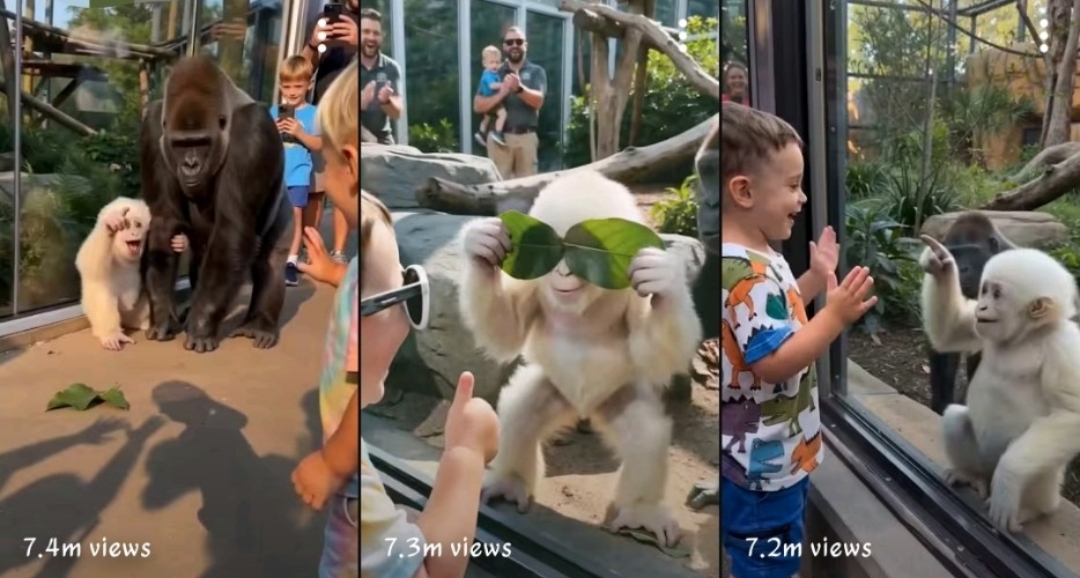
The main character is a small adorable white/cream-colored juvenile monkey, with fluffy pale fur, realistic skin around the face and ears, large expressive dark eyes, a small rounded muzzle, tiny fingers and highly expressive facial movements. The animal must look like a real living primate, NOT a cartoon, toy, CGI character, or fantasy creature.
A young child, approximately 5–7 years old, stands safely on the visitor side of a thick transparent glass viewing barrier. The child notices the monkey and becomes fascinated.
The monkey notices the child at the exact same moment.
The entire interaction should feel spontaneous, funny, wholesome and completely unscripted.
CORE 10–15 SECOND STORY STRUCTURE
0–2 seconds — Immediate Hook
Begin very close to the child and monkey through the glass.
The child smiles and slowly raises one hand toward the glass.
The white monkey immediately notices the movement, looks directly at the child’s hand, then looks into the child’s eyes.
No slow introduction. The interaction begins immediately.
2–5 seconds — The Monkey Responds
The child waves.
The monkey unexpectedly raises both tiny hands and waves back.
Its eyes widen with curiosity and its mouth opens slightly as if surprised.
The monkey takes one small step toward the glass.
The child’s expression changes from curiosity to delighted surprise.
5–8 seconds — Human-Like Reaction
The child makes a funny facial expression.
The monkey studies the child’s face carefully, tilts its head, then imitates the expression.
The child begins laughing.
The monkey reacts to the laughter by opening its mouth in a playful expression and gently bouncing on its feet.
8–11 seconds — Unexpected Twist
The monkey suddenly grabs a large green leaf from inside its enclosure.
It holds the leaf directly in front of its face like sunglasses.
The child bursts out laughing.
The monkey lowers the leaf, looks at the child, then raises it again as if intentionally playing a game.
11–15 seconds — Strong Ending
The child places both hands against the glass.
The monkey slowly places both tiny hands directly opposite the child’s hands.
They stare at each other for a brief emotional moment.
The monkey suddenly makes one final funny expression.
The child laughs loudly.
End on the monkey’s expressive face.
ENVIRONMENT
Modern accredited zoo habitat with a large clean glass viewing panel separating visitors from the animal.
Inside the enclosure:
– natural rocks
– thick branches
– climbing structures
– green tropical plants
– large leaves
– patches of soil
– realistic habitat enrichment
– natural sunlight
– subtle shadows
– realistic reflections on the glass
Behind the child, several visitors can be visible naturally watching and recording the interaction with smartphones.
Some spectators should react with genuine smiles and surprise, but they must remain secondary to the main interaction.
CAMERA STYLE
Authentic handheld smartphone footage.
Vertical 9:16 composition.
Camera should feel like a real visitor suddenly noticed something adorable and started recording.
Use subtle natural handheld movement rather than perfectly stabilized cinematic camera movement.
Occasional tiny focus adjustments.
Natural smartphone exposure.
Realistic depth of field.
No dramatic Hollywood camera movements.
No artificial zooms.
No impossible camera angles.
Keep the child and monkey clearly visible throughout.
The glass barrier should occasionally produce subtle realistic reflections and highlights without obscuring the subjects.
ANIMAL REALISM
The white juvenile monkey must behave like a real primate.
Include:
– natural blinking
– tiny eye movements
– subtle breathing
– realistic finger movement
– natural head tilts
– believable weight shifting
– realistic fur movement
– small ear movements
– subtle mouth and cheek movement
– realistic hand placement against the glass
Facial expressions should be expressive but biologically believable.
Do NOT make the animal speak.
Do NOT give the animal human teeth or exaggerated cartoon eyes.
Do NOT make the animal walk like a human.
CHILD REACTION
The child should react naturally rather than performing for the camera.
Start curious.
Then become surprised.
Then laugh genuinely.
The child should occasionally glance toward the person filming before immediately looking back at the monkey.
Keep the emotional progression authentic.
OPTIONAL VIRAL TWISTS
Randomly choose ONE twist per video:
1. Monkey copies the child’s wave.
2. Monkey copies the child’s funny face.
3. Monkey hides behind a giant leaf and suddenly pops back out.
4. Monkey pretends to be sleeping, then opens one eye at the child.
5. Monkey taps the glass repeatedly after the child walks away.
6. Monkey grabs a leaf and uses it like sunglasses.
7. Monkey copies the child’s clapping.
8. Monkey puts its tiny hand against the child’s hand through the glass.
9. Monkey becomes fascinated by the child’s colorful shirt.
10. A large dark silverback gorilla unexpectedly appears behind the white monkey, creating a dramatic size contrast.
11. Monkey notices the child’s stuffed animal and examines it through the glass.
12. Monkey copies the child’s head tilt.
13. Monkey waves goodbye, then quickly returns when the child waves again.
14. Monkey covers its face with both hands when the child laughs.
15. Monkey suddenly performs a playful little spin before returning to the glass.
VISUAL QUALITY
Ultra-photorealistic.
Authentic wildlife documentary realism.
Natural daylight.
Realistic fur physics.
Realistic skin texture.
Accurate animal anatomy.
Realistic glass reflections.
Natural environmental lighting.
High-detail smartphone footage.
4K realism.
No artificial beauty filter.
No excessive cinematic color grading.
No slow motion unless specifically requested.
AUDIO
Use only realistic environmental audio:
soft zoo crowd chatter,
children laughing in the distance,
birds,
subtle enclosure sounds,
natural animal sounds,
quiet footsteps,
occasional smartphone camera sounds.
The child’s laughter should be spontaneous and natural.
No background music.
No narrator.
No artificial sound effects.
STRICT NEGATIVE PROMPT
cartoon monkey, animated appearance, Pixar style, CGI animal, plastic fur, fake-looking eyes, distorted anatomy, extra fingers, missing fingers, extra limbs, malformed face, oversized head, human body proportions, human hands, talking animal, animal speaking words, unrealistic facial deformation, aggressive animal, animal attacking child, physical contact between child and animal, child inside enclosure, open enclosure, broken glass, unrealistic zoo, floating objects, duplicated people, duplicated animals, unnatural movements, teleportation, flickering, warped hands, warped faces, excessive camera shake, cinematic fantasy lighting, artificial lens flare, oversaturated colors, text, subtitles, watermark, logo.
Overall goal: make the viewer feel like they accidentally captured an incredibly funny and adorable real moment between a child and an unusually expressive white juvenile monkey at the zoo. The first second must immediately show the interaction, and the final moment must deliver a memorable cute or funny reaction that encourages replay.