Photorealistic Cinematic Wildlife-Video Aesthetic
Create a visually mesmerizing, ultra-photorealistic vertical short video featuring a tiny real-looking bird undergoing a spectacular magical transformation into an extraordinary floral/ornamental fantasy bird.
VIDEO FORMAT: Vertical 9:16. 1080×1920 minimum. Photorealistic cinematic wildlife-video aesthetic. Duration: 15–30 seconds depending on the concept. Designed for Facebook Reels, Instagram Reels, TikTok and YouTube Shorts.
CORE CONTENT FORMULA:
The video must begin with an ordinary-looking natural environment and a mysterious discovery.
A human hand slowly approaches a small natural opening in a tree trunk, moss-covered bark, branch, nest cavity, or another believable woodland location.
At first, the viewer sees little or nothing.
A tiny realistic bird slowly emerges from the opening.
The bird initially looks relatively normal and biologically believable.
The hand gently offers a finger or open palm.
The bird steps naturally onto the hand.
Once the bird is safely perched, the magical transformation begins.
Its feathers progressively expand, separate, unfold and reorganize into an extraordinary ornamental structure.
The transformation must happen visibly on camera rather than cutting directly from a normal bird to the final result.
The final bird becomes an unbelievable living combination of:
REAL BIRD + FEATHERS + FLOWERS + ORNAMENTAL PATTERNS.
The final reveal should be so visually unexpected that viewers immediately want to watch the video again.
SCENE STRUCTURE
0–3 SECONDS — MYSTERY HOOK
Start with an extreme close-up of a natural tree trunk.
Show realistic bark, moss, tiny plants, natural imperfections and a small dark hollow.
A human hand slowly enters the bottom of the frame and approaches the opening.
Camera movement should feel like someone discovering something unusual in the forest.
Do not reveal the bird immediately.
Create curiosity.
Natural forest ambience.
Subtle leaves moving in the background.
No narration.
No dialogue.
No text overlay.
3–6 SECONDS — BIRD DISCOVERY
A tiny realistic bird cautiously appears from inside the tree hollow.
The bird looks curious and alive.
Its eyes move naturally.
Its head makes tiny realistic movements.
It slowly walks toward the opening.
The human hand remains steady underneath.
The bird carefully steps onto the person’s finger or palm.
Keep the bird’s anatomy realistic.
Its feet must grip the finger naturally.
Show realistic claws, feathers, eyes, beak and body movement.
6–10 SECONDS — FIRST TRANSFORMATION
The bird begins changing.
Do NOT instantly replace the bird.
Instead, make the transformation physically visible.
Small feathers around the chest and wings begin expanding.
Individual feathers separate and become longer.
The colors gradually intensify.
Feathers begin arranging themselves into circular, petal-like or ornamental formations.
The transformation should look organic and magical rather than mechanical.
The bird remains alive and gently moving throughout the transformation.
The face and eyes remain recognizable.
10–15 SECONDS — MAJOR REVEAL
The plumage rapidly expands outward.
The wings and tail transform into an enormous symmetrical structure.
Depending on the selected concept, the feathers can become:
- roses
- lotus flowers
- chrysanthemums
- daisies
- layered flower petals
- peacock-eye patterns
- mandala designs
- heart-shaped feather formations
- butterfly-like wings
- circular ornamental patterns
- geometric feather mosaics
- jewel-like feather arrangements
- intricate lace-like feather structures
Flowers must appear organically integrated with the feathers.
They must NOT look glued onto the bird.
The bird’s body remains anatomically believable while its plumage becomes fantastical.
15–20+ SECONDS — HERO REVEAL
Reveal the completed transformation.
The bird is now surrounded by a spectacular radial arrangement of feathers and flowers.
The final silhouette should be large, symmetrical and visually dominant.
Hold the final composition long enough for the viewer to understand what they are seeing.
The bird looks directly toward the camera or slightly turns its head.
Its eyes remain extremely sharp.
The feathers subtly move with natural air movement.
The flowers and feather structures gently sway.
Camera slowly pushes closer to the final design.
END on the strongest visual frame.
TRANSFORMATION PHYSICS
The transformation is the most important part of the video.
Use continuous biological-looking movement.
Individual feathers should:
grow, lengthen, rotate, spread, overlap, curl, unfold, multiply naturally, and reorganize into the final ornamental structure.
Flower-like formations should emerge from feather structures.
Do not use teleportation.
Do not use instant morphing.
Do not use hard cuts during the transformation.
The viewer should be able to watch the impossible transformation happening in real time.
The transformation should feel like magical biological evolution.
BIRD DESIGN
Use ONE main bird per video.
Possible bird types:
small tropical songbird, fantasy finch, tiny exotic parrot, miniature peacock, colorful forest bird, small kingfisher-inspired bird, fantasy pheasant, small ornamental bird, hummingbird-inspired fantasy bird, small blue bird, small red bird, tiny white bird.
The bird must remain recognizable.
Avoid generic AI bird anatomy.
Maintain:
two eyes, one beak, two wings, two legs, realistic feet, natural feather direction, correct body proportions.
FANTASY TRANSFORMATION THEMES
Choose ONE primary transformation concept per video.
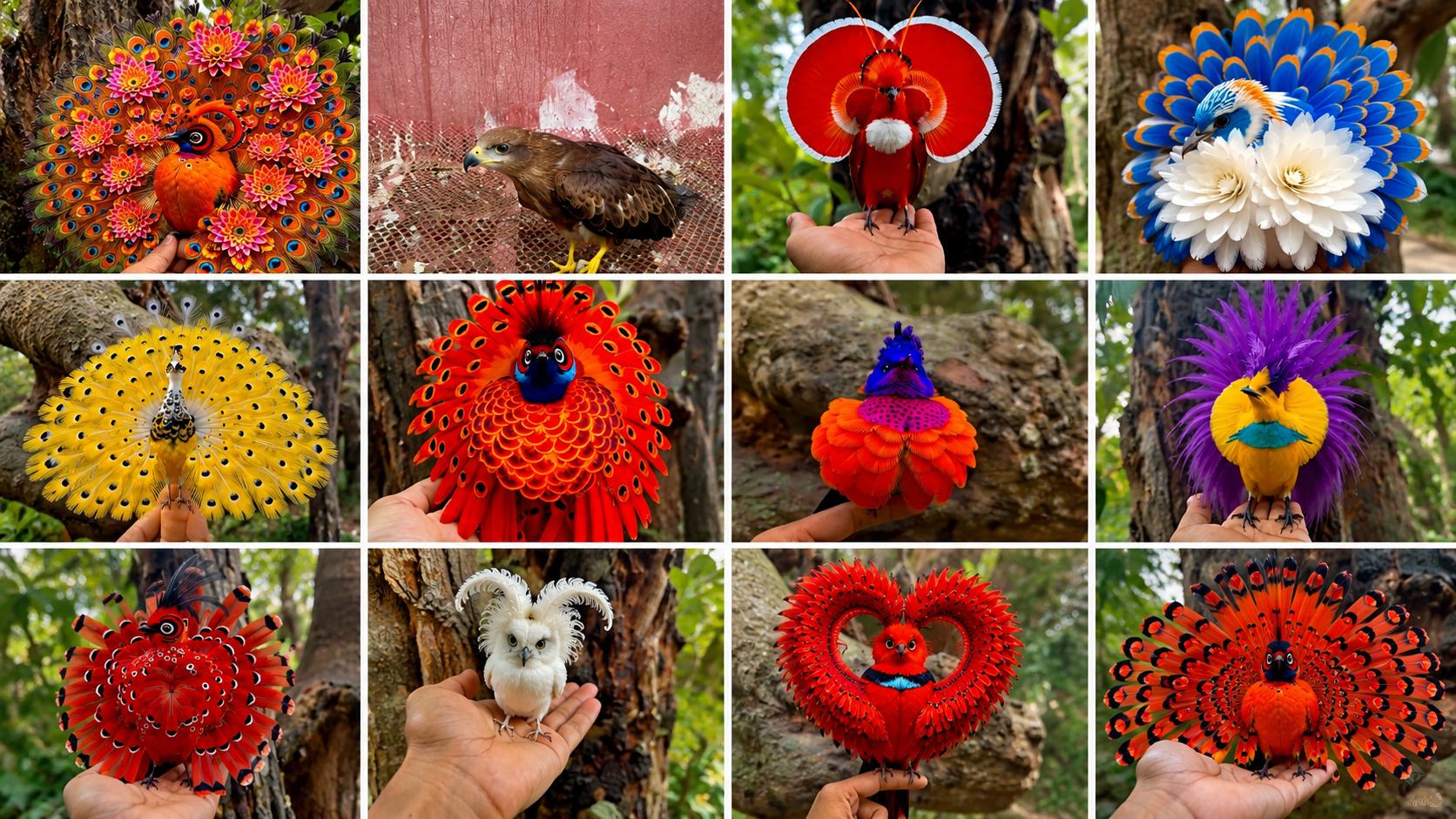
FLOWER PEACOCK: A small blue bird gradually develops enormous peacock-like feathers covered in pink and turquoise flowers.
ROSE BIRD: The bird’s feathers expand into layers of realistic red and white roses.
LOTUS BIRD: Blue, purple and white feathers unfold into giant lotus-petal structures.
CHRYSANTHEMUM BIRD: Hundreds of layered orange, yellow or red feather-petals create a massive chrysanthemum silhouette.
MANDALA BIRD: The bird develops perfectly arranged circular feather patterns resembling an intricate living mandala.
BUTTERFLY BIRD: The wings expand into colorful butterfly-inspired feather structures while retaining realistic feather texture.
HEART BIRD: The tail and wings reorganize into a large symmetrical heart shape.
SUNFLOWER BIRD: Golden-yellow feathers expand into a giant sunflower-like formation surrounding the bird.
BLUE JEWEL BIRD: Blue, cyan, turquoise and white feathers form intricate jewel-like circular patterns.
RED FIRE BIRD: Deep crimson, orange and black feathers form a dramatic fiery floral structure.
WHITE ANGEL BIRD: White and ivory feathers expand into enormous soft flower-like wings with subtle gold details.
PURPLE DREAM BIRD: Violet, lavender and deep-purple feathers transform into layered flower petals.
RAINBOW BIRD: Highly controlled iridescent colors gradually appear across the feathers, producing a spectacular multicolor final reveal.
ENVIRONMENT
Keep the environment realistic.
Preferred locations:
moss-covered tree trunk, large old tree, tree hollow, forest branch, woodland garden, tropical forest, natural garden, tree cavity.
The background should contain realistic:
bark texture, moss, leaves, branches, small plants, natural sunlight, subtle wind movement, depth and atmospheric perspective.
Use shallow depth of field.
Keep the background slightly blurred while maintaining enough environmental detail to make the scene believable.
HUMAN HAND
When the hand is used, it must look completely real.
Natural adult human hand.
Correct anatomy.
Correct finger proportions.
Natural skin pores and texture.
Natural fingernails.
No extra fingers.
No fused fingers.
No distorted joints.
The hand should gently support the bird without squeezing it.
The bird should naturally grip the finger or stand on the palm.
CAMERA STYLE
The entire video should feel like a person unexpectedly discovered an incredible tiny creature in nature and filmed it with a modern premium smartphone.
Use:
vertical handheld framing, subtle natural camera shake, realistic autofocus, occasional tiny focus adjustment, natural exposure changes, realistic smartphone dynamic range, shallow depth of field, close-up wildlife framing, natural perspective, realistic motion blur.
Avoid an obvious CGI camera.
Do not make the camera movements overly cinematic.
The footage should feel spontaneous but visually beautiful.
LIGHTING
Natural outdoor daylight.
Soft sunlight filtering through trees.
Realistic highlights on feathers.
Natural shadows.
Subtle reflections in the bird’s eyes.
No studio lighting.
No artificial neon glow.
No excessive magical light beams.
The magic should come from the transformation itself.
AUDIO
NO SPOKEN DIALOGUE.
NO NARRATOR.
NO HUMAN SPEECH.
Use only natural environmental audio:
soft birdsong, light forest ambience, gentle leaves, subtle wind, tiny wing movements, soft feather rustling, quiet magical transformation sounds if desired.
The transformation sound should be extremely subtle and organic.
Do not use loud cinematic explosions.
Do not let music overpower the visual experience.
VIRAL HOOK
The first 2–3 seconds must create immediate curiosity.
The viewer should wonder:
“What is inside that tree?”
Then:
“Wait… is that a bird?”
Then:
“How are its feathers doing that?”
The final transformation must provide a strong visual payoff.
The final frame should be highly symmetrical, colorful and satisfying.
Create a seamless visual progression that encourages replay.
PHOTOREALISM RULE
The fantasy element may be impossible, but EVERYTHING around it must look real.
Real bird anatomy. Real feathers. Real hand. Real tree bark. Real leaves. Real shadows. Real sunlight. Real depth of field. Real environmental movement.
The fantasy plumage must have physically believable feather texture.
Do not make flowers look like flat stickers.
Do not make feathers look like plastic.
Do not make the bird look like a toy.
The final creature should look like an impossible species that was somehow photographed in the real world.
CONTINUITY RULE
The SAME bird must remain present throughout the entire video.
Do not change:
bird species, face, eye color, beak, body, location, hand, lighting, camera position, background.
Only the plumage should progressively transform.
The bird must remain in the same physical position while the transformation occurs.
NEGATIVE PROMPT
cartoon, anime, illustration, painting, obvious CGI, 3D render, plastic bird, toy bird, fake feathers, pasted flowers, glued flowers, floating flowers, costume, clothing, mechanical transformation, instant morph, teleportation, hard transformation cut, duplicate bird, multiple heads, extra eyes, extra wings, extra legs, malformed beak, distorted face, deformed claws, extra fingers, fused fingers, deformed hand, floating hand, unnatural bird movement, melting feathers, blurry bird, low-detail feathers, flat flowers, fake background, artificial studio lighting, neon glow, excessive particles, text, captions, logos, watermark, frame, border, collage.
MASTER CREATIVE RULE
Every new video must have a DIFFERENT bird + DIFFERENT transformation + DIFFERENT color palette + DIFFERENT final silhouette.
Never repeatedly use the same flower arrangement.
Never repeatedly use the same color combination.
Never make two consecutive videos visually identical.
The goal is to create the feeling that every video reveals a completely new impossible bird species.
FINAL RESULT:
A breathtaking ultra-photorealistic vertical wildlife discovery video where an ordinary tiny bird emerges from nature and progressively transforms into an extraordinary living masterpiece of flowers, feathers and ornamental patterns.
The first seconds create mystery.
The middle creates anticipation.
The transformation creates the WOW moment.
The final reveal creates the replay.